


Deaf Culture in Courses and Pop culture
Many cultures identify with aspects such as clothing choices, food, and music while other groups are identifiable by language as well. The Deaf community was built out of language. I expanded my knowledge of the Deaf community by taking an introductory American Sign Language Course and reading the novel True Biz by Sara Nović. Each of these resources taught me more about how important a culture built out of language can be to the community’s well-being.
When I first registered for my Introduction to American Sign Language Course, it was due to a need for a general education course. When I initially logged onto zoom for this all-online class I had expected a hearing instructor who would speak to us and teach sign. Instead, it surprised me to find my instructor was completely deaf. This seemed to work well on zoom since he could use the chat for communication, and he immersed us directly with the language. Usually, this type of immersion strategy works well for languages, in a way you are forced to pick up on the words to follow along. This form of teaching helped make me excited to come to class. I believe I could have learned similar values with a fluent ASL instructor that was hearing but this felt like a more authentic experience. I think a hearing instructor telling us about the Deaf community with not much connection through family would have felt like reading a textbook. We began with simple learning like the alphabet, how to ask questions, say our name, and simple family words. The instructor spoke of his family in ASL once we knew the words, some of the sentences I was still only picking up the fragmented meaning. This was frustrating because I wanted to know the whole story, but it also made me feel proud that I understood as much as I was. He explained his wife and children were born hearing, but all were fluent in ASL. I wondered what that would have been like, not only to use ASL as the primary household language but to have a bilingual household in general. I grew up only speaking English but had a friend who spoke Spanish at home and her parents only knew a small amount of English. I can imagine that people who speak multiple languages excel as adults and can connect with multiple people, but as children, it could be confusing to distinguish grammar in school and at home. In ASL, there is not much of a grammar component at all since you are speaking with general ideas. The nature of being in a “quiet home or class” initially changed my brain and threw off my senses. I have never been in a zoom class where everyone is muted; it was shocking. Although, I put “quiet home or class” in quotes because it is not truly quiet, there is plenty of noise and conversation occurring just not in the way the mainstream world perceives noise.
One unit for this course was about proper etiquette in the Deaf community. In a verbal conversation, it is proper knowledge that you should not interject when another person is talking. Similarly, one must wait and listen to another person signing before they can respond. It is a basic rule that you should not walk in between a verbal conversation which is the same for a signed conversation although, people unaware of these similarities may walk in between two people signing. To get the attention of someone who is hearing you could say “hello” behind them but to get the attention of a deaf person respectful ways to connect include tapping them on the shoulder lightly or waving towards them. Learning about different cultures in this way has taught me that you should do your research when you are faced with someone different than yourself. It is easy to get caught up in what you think is the correct way to approach things based on your upbringing or culture when the actions you have taken are seen negatively by the other person. I can utilize my knowledge of the deaf community from class to approach situations when working with the public in the future.
I came across deaf people at my customer service job as a cashier where we were trained to greet the customer. When the customer did not say anything, I continued scanning their items and usually the person they were with responded with “she’s deaf” I remember responding with an “okay” and simply smiling at the person who did not understand me. I did not feel confident using the little sign I had learned to try and communicate in most situations but tried one or two times. If there was a hearing person with them, I am disappointed that I was more inclined to not use my sign language. It was the easy way out and I intend on changing that in the future by engaging to some extent even if it is just a “hello” or “goodbye”. It was scary to attempt to speak another language with a small word bank, but I have always heard it is better to try and fail than not try at all. When I tried to use my knowledge, it was reciprocated well and encouraged me to do so more often. My Spanish knowledge was far greater and fluent speakers seemed to feel more comfortable conversing even when my Spanish was broken. This class gave me a base knowledge of Deaf culture, but my supplemental pop culture resource taught me much more about the cultural oppression and what is frowned upon within the Deaf community.
The pop culture source I dove into after my class was True Biz by Sara Nović. This fictional novel follows three main characters all connected by a school for the Deaf. Charlie is a deaf girl with hearing parents who have just been divorced. Both parents disagreed over the need to teach sign language or use cochlear implants, a device that allows sounds to be heard. This device seemed to be frowned upon by other characters that had been involved with the Deaf community for many years. Cochlear implants degrade the Deaf culture and are seen as a tool to appeal and conform to hearing people. Although it is stressful to make new friends when you do not know how to speak the language everyone else is using, Charlie finds community when she is finally sent to the Deaf school. Another character, Austin, is a fifth-generation deaf person. His family is very proud of their heritage, but when his sister is born and declared hearing, conflict arises when the hearing father seems proud. When Austin’s baby sister is later found to be deaf there is much conflict in the family to use cochlear implants, so they do not need to make another announcement. This is not taken lightly by the Deaf people in the family due to their belief that the devices force the Deaf to conform with hearing people. In reading this novel, I saw directly how ethnocentrism, the belief that one’s own culture is superior to the other, played a role in the oppression of culture. Cochlear implants imply a hearing life is preferred and normal. They imply hearing people are above Deaf people and cochlear implants are the only way to advance in society. With this in mind, I have begun to achieve a sense of ethnorelativism that all cultures are equally valid and can be understood in relation to one another. Each character in this novel could achieve the same success and tasks as a hearing person. The cochlear implants discussion in this novel displayed the issues between different cultures that can arise and how cultures can have the same conflict among each other. I will apply my sense of ethnorelativism when working on a team of people or the public. With the view that no one person is superior, a more balanced and positive environment can occur where each person uses their strengths.
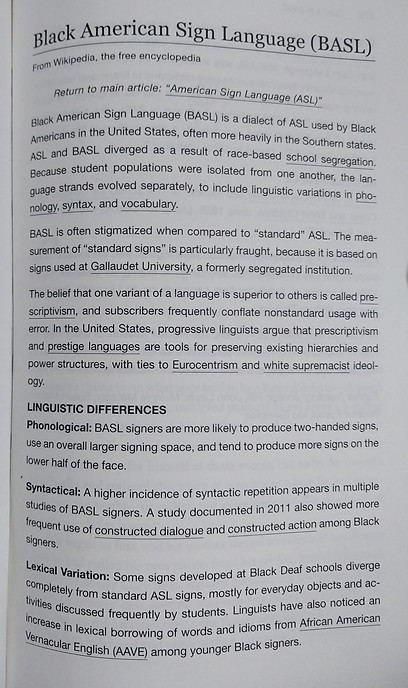
The images below are two pages from True Biz. The author provided relevant history of Deaf culture within the novel. I thought this particular portion was important due to the connected relationship between race and ethnicity. This portion also explains the role segregation had on American Sign Language for black people compared to white.

These experiences have given me a deeper understanding of the oppression in cultures and language’s impact on culture. The Deaf community was created out of unity in a language which correlates with the importance sign language has to Deaf culture. Knowing parts of this language will help me to better connect with members of the Deaf community and approach them with compassion. A greater knowledge of the oppression Deaf people face along with many other cultures sheds light to the idea of ethnorelativism where all cultures are equal, and each bring an important role to a team. Leading a diverse team is one of my major career goals. In this role, a diverse team is crucial for different prospectives and may be helpful when working with landowners to study animals.