


Interconnected Cultures
Intercultural engagement previous to my experiences meant numerous cultures interacting with each other in a civilized and kind manner. I still believe that is true, but after my exposure to cultural events, I have found it is important to celebrate differences and learn from each other. It is the best way for everyone to grow with understanding instead of just being kind in passing.
The first cultural encounter I had was at the Dia de Los Muertos (translates to “Day of the Dead) event in Mankato. I had learned of this celebration in past Spanish classes, and it is something I have always wanted to experience. In class, Dia de Los Muertos is described and compared to the American Halloween holiday since it occurs around the same time (October 30th to November 1st) although, Dia de Los Muertos is not scary by any means. Mexicans decorate elaborate altars with pictures of family members or friends who have passed and symbols representing water, earth, wind, and fire. Water is presented in a pitcher for the spirits to drink. Pan de Muertos (translates to “bread of the dead”) is for the spirits to eat, representing earth. Papel picado, colorful paper banners with symbols cut out such as skulls portray wind. Fire is illustrated through the many candles lining the path to the altar and on the display. Orange marigolds are also included which are abundantly blooming this time of year in Mexico. This pungent flower is believed to draw the spirits to the “ofrendas” (translates to “offerings”) their loved ones have provided.
At the celebration in Mankato, I got to see these decorations firsthand and immerse myself in the joy of this Mexican holiday. In addition to the ofrenda decorations I saw colorful balloons, flags, statues of skeletons and statues of colorful animals. The numerous colors are something I do not see often in the culture in which I grew up; color schemes or neutrals are valued more. For example, typical Halloween colors are black and orange, but purple has started to be included. When we first arrived, there was a traditional dance performance with people of all ages. One thing I found fascinating that is different from my culture was that only a drum kept a steady beat, and all other music was produced by maracas and whistles. The performers also had shakers attached to their legs by a sock around their ankle that made noise when moved. The traditional clothing was bright, colorful, loose and flowy; sequins covered the women’s skirts and men’s pants. The dancers wore head bands with a fan of feathers. In the culture I grew up in, music is produced through singing and loud instruments like guitars or horns, but this music was much more natural and subtle. Drums and shakers are used regularly for American music, but they tend to be the “steady beat” and not the featured instrument. The Mexican music made the drum the main instrument. Further, the music was in tandem with the movement as opposed to the music being the priority. Decorations and dancing were just one portion of this celebration though, food and homemade items were sold. I was in awe of beautiful homemade items such as jewelry, shoes, hats, towels and baked goods. The shoes and jewelry were decorated with or made from colorful beads. The originality and authentic items are something that lacks in my culture. In my view, most things are made by other countries. When there are handmade items, they are in small amounts and are generally marked up in price. Of the food sold, my friends and I shared a traditional dish called pupusas which was a corn-based bread with cheese in the middle that was dipped into a tangy orange sauce. A side salad dish of an assortment of fresh vegetables (corn, salad greens, cabbage) accompanied the main course. For dessert we share a piece of tres leches cake, a light cake soaked in three kinds of milk.

The colorful balloons and skulls were eye catching at the entrance of the event. (above)
The homemade shoes and bags were high quality. (right)

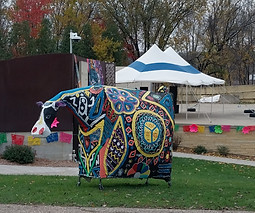
A decorated cow is displayed with papel picado hanging behind. (below)
My second culture event was similar in nature but had different means for celebrating. I attended the “Mahkato Powwow or Wacipi” (Wah-CHEE-Pee meaning “dance” in Dakota). Mahkato was the original name for Mankato before the English refined it to their language, this is one of the many instances of repression in this culture. Decorations for the Powwow were much simpler than the Mexican Dia de Los Muertos Celebration. There was a circle formed by benches and bleachers in the middle of Land of Memories Park in Mankato. In the middle of the ceremonial circle there were a few flags (US, Canada, tribal flags, POW/MIA). I learned the United States flag has significant meaning to the Dakota, reminding them of all the ancestors who fought for the country. This was the extent of the decorations. More focus was placed on the Grand Entry (ceremonial dance) and the drums. The Grand Entry is a performance that depicts the history of Native Americans from ancient customs to encounters with white people. The ceremony symbolizes the gathering of Indigenous people as well as their unity, pride, and cultural reverence. The Mankato celebration also honors the 38 Dakota that were hung and allows the descendants of these people to feel comfortable returning to their home. People enter the ceremonial circle according to age, elders first and youth at the end. Similar to the Dia de Los Muertos dance, there were people dancing of all ages. I have loved seeing how age inclusive these events are when I have grown up in a culture where there is a “kids table” or “adult only” parties. Feathers were included in all outfits but specifically, 38 eagle feathers that represented the 38 Dakota that were hung. Each outfit was made and personalized by each person and all outfits have special meaning. There was a requirement in the program that you could not take individual pictures of the people in their regalia (traditional outfit). The music consisted of the drum circle with men making a steady beat with other vocalizations. This was the main feature again, with bells and metal attached to the dancer’s dresses and shoes that make noise with movement. This ceremonial dance felt different than Dia de Los Muertos though, there was a more serious tone, and more education involved with a speaker explaining the meaning in between dances. For example, the circle was meant to be treated like a church where only dancers were to be. It is a celebration to honor decedents and share culture with the public for education, but a ceremony that is sacred to the history of the Dakota people.
Analogous to Dia de Los Muertos, there were vendors selling homemade bead crafts, shoes, and food. It was amazing to see how complex simple bead crafts could be between the two cultures as opposed to the simple one-layer American bead bracelet. Each of the Dakota and Mexican beaded bracelets had multiple layers across and vertically. I was disappointed to see that the food trucks were mostly Americanized foods like cheese curds or tacos. One truck was selling Frybread, a dish originally developed due to the Unites States government forcibly moving Native Americans to reservations. This bread was made from the inadequate rations the government provided to the Native Americans such as flour, lard, and salt. Knowing the oppressive history behind this dish is unsettling. My culturally knowledgeable partner warned me that this dish was fairly Americanized, likely due to the influence from the government, but I was excited to try something traditional. It came out of the food truck freshly fried and plain; I was surprised by its large size. We added cinnamon sugar for flavor, but they also had honey and jelly for toppings. I reflect on the privilege I have to add flavor to this meal when fried, plain bread was the sole meal of the Dakota in the past. One thing the Dakota were selling that was different than anything I had seen before was animal furs and jackets made from the fur. As an animal lover this was initially unsettling, but I began to remember history classes and how important animals were to Native Americans. They respect the land and do not waste any part of the animal; this provided comfort for me.
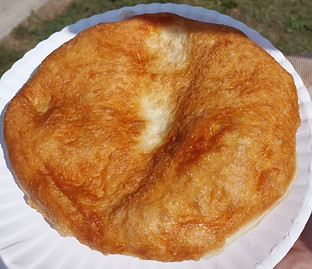

The Frybread before adding toppings. (left)
Beaded necklaces, bracelets, and hair barrettes sold by vendors. (right)
The third culture event I attended was Indigenous People’s Day at Mankato East High School. When I first entered the building, I was stopped and encouraged to jump into the planetarium showing that had just started so I went in and sat down. The small auditorium had a large dome screen that displayed the stars. It reminded me of the omni theater at the Science Museum in St. Paul and made me jealous that I did not have anything similar in my high school. The speaker was a white astronomy teacher at the school, and I was expecting a native person, but he seemed to have great resources on the culture and extensive knowledge of astronomy. I remember him pointing out the milky way and explained the native people believe that it is representative of the Mississippi river, and it is where the ancestors walk. He pointed out constellations like the big dipper and others, explained their Greek meaning and then the stories the Dakota tell. A few of the other constellations had Dakota meanings regarding the birth of a child and the importance of the child or special characteristics they may have when they get older.
The vendors at this event were selling similar things to the powwow such as beaded bracelets and furs. Although I saw several different items like dried fruit, jams, arrow heads, turtle shells, animal skulls, horns, and decorative stone knives. I was exhilarated to see not only the animal parts used but also stones. As stated previously, this is something I have learned about in history books and classes but not seen in person. I applied my previous knowledge with real world people. Unfortunately, having an evening class meant I missed out on some of the cultural demonstrations later in the night that I wanted to see but I did get to listen to a Dakota speaker, Steve Tamayo, just before heading out. He spoke about the Dakota language in comparison to English and the meanings connected to the city and state. In Dakota, “Mahkato” (or Mankato) means earth blue or slightly cloudy waters. Tamayo said the Dakota do not have a word for “animal” because they believe they are all interconnected and see animals as neighbors. This allowed me to reflect on their immense tie to and care for the natural world. Further, there is no word for goodbye in the Dakota Language it is always “see you in the next passing”. In my cultural upbringing, you could say goodbye to someone with the intent of never seeing them again. I have done this and listening to another culture’s view on this has made me reflect on my own morals. With the “see you in the next passing” mantra, it encourages me to be more kind to everyone you meet because it is a small world, and you are likely to cross paths again. Tamayo conveyed the oppression the Dakota have endured for many years and explained how the groups are just starting to gain some freedom and recognition. He spoke of his own Mexican-Dakota background; a full circle moment for me realizing that cultures are not as separate as we make them in books. When you meet real people, they are all intertwined and connected.

Although these items sold by vendors were likely not functional, it was fascinating to see the quality of the products and what each part was made from.
To summarize, these events have expanded my understanding of cultures from simple textbook knowledge to personal experience. I learned more about the oppression of the Dakota people, and it allowed me to reflect upon my white privilege and identity. I can utilize this dynamic power to speak up when negative terms are being used or the culture is spoken of incorrectly when with peers or future colleagues. I may use this knowledge when working with landowners or leaders of native groups during habitat restoration projects in my future career. I will have to do more research into the specific land and importance, but I have the sympathy to enter the situation in the right mindset to understand the history related to oppression.